 US: 2-4 weeks,
  Europe: 1-2 weeks, 🌍 Worldwide: 1-4 weeks ✈️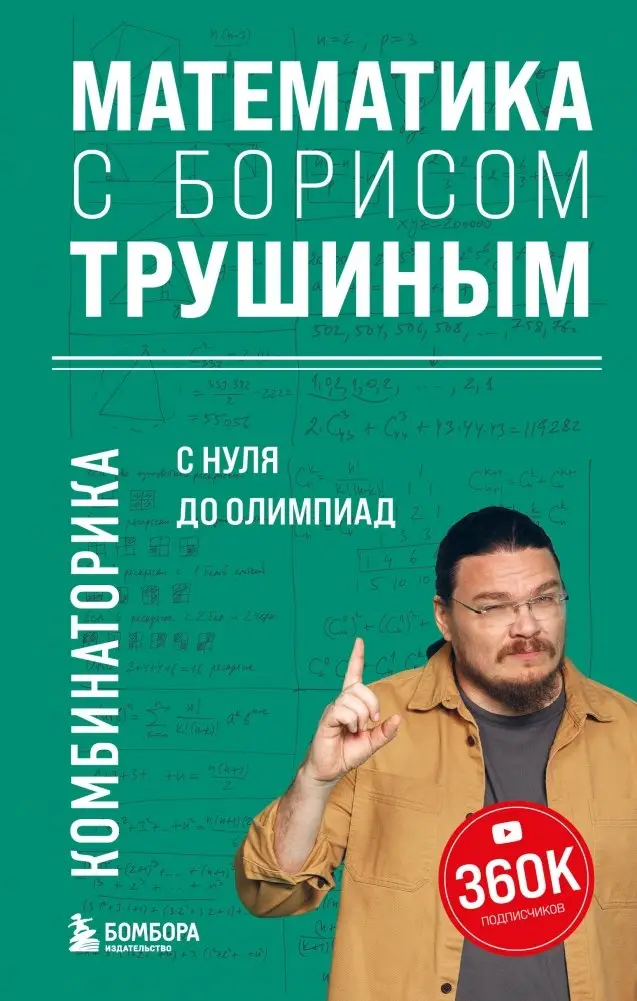
Математика с Борисом Трушиным. Комбинаторика: с нуля до олимпиад | Mathematics with Boris Trushin. Combinatorics: From Zero to Olympiads
By Трушин Борис Викторович
Математика с Борисом Трушиным. Комбинаторика: с нуля до олимпиад
Трушин Борис Викторович, 2023, серия «Математика с Борисом Трушиным»
Обзор
Книга Бориса Трушина, автора популярного канала о математике, предлагает читателям углубленное изучение комбинаторики, начиная с самых основ и заканчивая задачами олимпиадного уровня. Материал основан на авторских видеороликах, что обеспечивает преемственность и узнаваемый стиль изложения. Комбинаторика, как раздел математики, находит применение в различных областях, от теории вероятностей и статистики до информатики и криптографии. Понимание комбинаторных принципов необходимо для решения задач, связанных с подсчетом вариантов, анализом данных и оптимизацией процессов.
В книге последовательно рассматриваются основные понятия и методы комбинаторики: перебор вариантов, бином Ньютона, треугольник Паскаля. Особое внимание уделяется решению задач различной сложности, что позволяет читателям постепенно развивать свои навыки и углублять знания. Автор стремится не просто познакомить с теоремами и формулами, а помочь читателям понять и прочувствовать их суть, что способствует более глубокому и прочному усвоению материала. Книга станет надежным помощником для всех, кто хочет освоить комбинаторику и успешно применять ее на практике.
Кому подойдёт
- Школьникам, готовящимся к математическим олимпиадам.
- Студентам, изучающим дискретную математику и теорию вероятностей.
- Учителям математики, ищущим дополнительные материалы для занятий.
- Любителям математики, желающим расширить свои знания.
- Всем, кто интересуется комбинаторными задачами и их применением.
Ключевые особенности
- Автор – известный популяризатор математики Борис Трушин.
- Книга основана на материалах авторского YouTube-канала.
- Рассматриваются задачи от простого к сложному.
- Твердая обложка обеспечивает долговечность издания.
- 240 страниц с подробным изложением материала.
- Издательство «Эксмо», 2023 год.
- Возрастная категория: 12+.
- Штрих-код: 9785041796785.
Mathematics with Boris Trushin. Combinatorics: From Zero to Olympiads
Boris Trushin, 2023, series: «Mathematics with Boris Trushin»
Overview
This book by Boris Trushin, the author of a popular mathematics channel, offers readers an in-depth study of combinatorics, starting from the very basics and ending with problems at the Olympiad level. The material is based on the author's videos, which ensures continuity and a recognizable style of presentation. Combinatorics, as a branch of mathematics, is used in various fields, from probability theory and statistics to computer science and cryptography. Understanding combinatorial principles is necessary for solving problems related to counting options, analyzing data, and optimizing processes.
The book consistently examines the basic concepts and methods of combinatorics: going through options, the binomial theorem, Pascal's triangle. Special attention is paid to solving problems of varying complexity, which allows readers to gradually develop their skills and deepen their knowledge. The author seeks not only to introduce theorems and formulas, but to help readers understand and feel their essence, which contributes to a deeper and more solid assimilation of the material. The book will be a reliable assistant for anyone who wants to master combinatorics and successfully apply it in practice.
Who it's for
- High school students preparing for mathematical Olympiads.
- Students studying discrete mathematics and probability theory.
- Mathematics teachers looking for additional materials for classes.
- Math enthusiasts wishing to expand their knowledge.
- Anyone interested in combinatorial problems and their applications.
Key features
- Author: Boris Trushin, a well-known popularizer of mathematics.
- The book is based on materials from the author's YouTube channel.
- Problems are considered from simple to complex.
- Hard cover ensures the durability of the publication.
- 240 pages with a detailed presentation of the material.
- Publisher: Eksmo, 2023.
- Age category: 12+.
- ISBN: 9785041796785.